
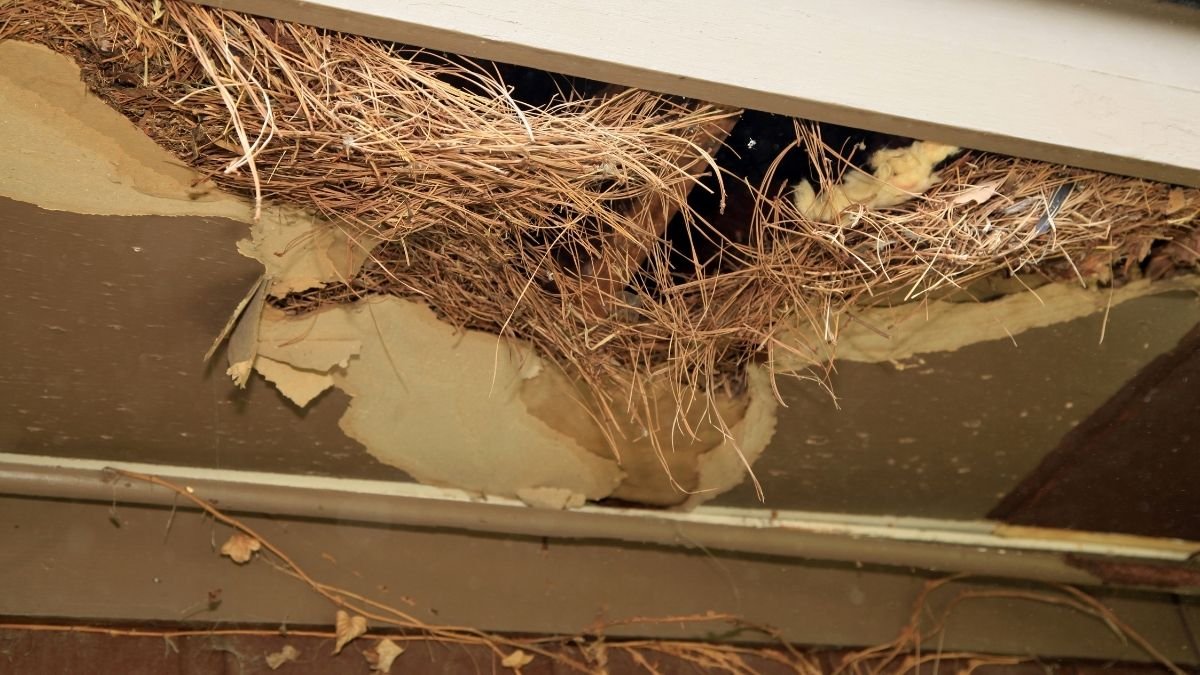
A rat nest is a loose, messy ball of shredded insulation, paper, cardboard and fabric, usually about the size of a softball or bigger, tucked into a dark, quiet spot such as an attic, wall void or basement corner.
If you have found one, or you only suspect one because of scratching at night, this guide helps you confirm it, locate it and stay safe around it. As GTA temperatures drop, rats look for warm places to settle, which is why nests turn up more often from late fall onward (see why rats move indoors in winter).
What Does a Rat Nest Look Like?
A rat nest looks like a rough, loosely packed ball or heap of shredded material, often 10 to 15 cm (4 to 6 inches) across, and larger when several rats share it. Expect chewed paper, cardboard, insulation and fabric, with droppings and a sharp ammonia smell close by.
Rats are not neat builders. They gnaw whatever soft or fibrous material they can reach, pull it into a hidden space and pack it into a warm hollow. A nest can look like a bird’s nest without the twigs, or like torn-up junk mail stuffed into a corner. Rats keep adding material, so a small nest can grow noticeably within a couple of weeks.
| Feature | What you will usually see |
|---|---|
| Size | About 10 to 15 cm (4 to 6 inches), larger with a big litter |
| Materials | Shredded insulation, paper, cardboard, fabric, packaging |
| Location | Dark, undisturbed spaces close to food and water |
| Smell | Musky, ammonia-like odour from urine |
| Built by | Usually Norway (brown) rats in the GTA |
Norway rat nests vs. roof rat nests
The Norway rat (also called the brown rat) is the species most GTA homeowners deal with. It prefers low spots, so its nest is more likely in a basement, crawl space, garage or under a deck. Roof rats are slimmer, climb well and favour high places such as attics, but they are much less common in Ontario. A nest at ground level most likely belongs to a Norway rat.
Rat burrows outdoors
Outside, Norway rats often dig burrows instead of building a visible nest. Check along foundations, under sheds and decks, beside compost bins and beneath woodpiles. A typical entrance is a hole roughly 5 to 10 cm (2 to 4 inches) wide with smooth, packed edges. The City of Toronto notes that rats live in burrows near ground level, usually around buildings, and may travel up to 100 feet from them, according to its rat control guidance.
Nearby construction can push rats toward your property, a pattern we cover in construction pushing rats into homes.

How Can You Tell a Rat Nest From a Mouse Nest or a Bird Nest?
Size, materials and droppings give it away. Rat nests are larger and rougher than mouse nests and use chewed household scraps. Bird nests are woven from twigs and grass, usually outdoors. Rat droppings are about 2 cm (¾ inch) long, while mouse droppings are only about 6 mm.
| Feature | Rat nest | Mouse nest | Bird nest |
|---|---|---|---|
| Size | 10 to 15 cm or larger | Fist-sized or smaller | Varies, neat cup shape |
| Materials | Shredded insulation, paper, fabric | Fine, fluffy shredded fibres | Twigs, grass, leaves, mud |
| Typical spot | Attics, wall voids, basements, burrows | Drawers, cupboards, small wall gaps | Eaves, vents, chimneys, trees |
| Droppings nearby | About 2 cm, capsule-shaped | About 6 mm, rod-shaped | White and chalky |
If the nest is tiny and sits inside a wall cavity or drawer, read our guide to mice in walls before assuming it is a rat. Size alone is not foolproof, since a young rat’s nest can be small, so check the droppings too.
Where Do Rats Nest in a House?
Rats nest in dark, quiet, warm spaces near food and water. In GTA homes that usually means attic insulation, wall voids, basements, crawl spaces and the gaps behind appliances. They also use garages, sheds, space under decks and, occasionally, a parked car’s engine bay.
Our post on the hidden places pests live covers more spots homeowners tend to miss.
Attics and insulation
Fibreglass and cellulose insulation are easy to tunnel through and shred. Look for flattened trails, dark greasy smears and clumps of torn insulation near the eaves or around pipes.
Wall voids and ceilings
Scratching or gnawing that moves through a wall at night often points to a nest in the cavity. You usually cannot see this kind of nest without opening the wall, which is a job for a professional.
Basements, crawl spaces and behind appliances
Norway rats favour the lowest level of the home. Check behind the furnace, water heater, washer and dryer, and along the base of stored boxes. Stacked cardboard is a favourite building material.
Garages, sheds, decks and car engines
Detached spaces get less foot traffic, so they suit rats well. A nest in a car engine is less common, but it can happen when a vehicle sits unused. Signs include shredded material on the engine, chewed wiring and a stale smell from the vents.
How to Find a Rat Nest
Start with the signs, not the nest. Pay attention to noise coming from a particular corner at night, follow droppings and grease marks to their source, then use a flashlight to scan nearby dark spots. Look but do not touch or reach in. Rats usually nest within about 10 to 30 feet of food, so work outward from the most activity.
- Listen after dark. Scratching, squeaking or thumping in a ceiling or wall helps narrow the area.
- Follow the droppings. A cluster of dark, capsule-shaped droppings along a wall often marks a route toward the nest.
- Check for rub marks and gnaw marks. Rats leave greasy smudges along walls and pipes where their fur brushes the same path again and again.
- Scan with a strong flashlight. Check attics, corners behind storage and gaps under stairs. A phone camera on a long stick lets you see into tight spaces without reaching in.
- Search near food and water. Look around kitchens, pantries, pet food and leaky pipes.
- Stop if you see a nest or babies. Back away and do not poke it. A nesting female can bite to defend her young.
How Do You Know if a Rat Nest Is Still Active?
An active nest has fresh signs around it: soft, dark, shiny droppings, a strong ammonia smell, new chewing, and night-time sounds from the same space. A dry, dusty nest with old grey droppings may be abandoned, but you cannot be sure without an inspection.
- Droppings are dark, soft and shiny rather than grey and crumbly.
- The smell is strong and musky, and worse near the nest.
- Insulation, paper or fabric looks freshly shredded, not flattened and dusty.
- You hear scratching or squeaking at night in the same area.
- A light dusting of flour or a sheet of tissue paper across a runway shows tracks or gets moved by morning.
Several signs together point to an active nest. Either way, an old nest still needs proper clean-up, because dried waste and nesting material can stay contaminated.
Is It Dangerous to Touch or Remove a Rat Nest?
It can be. Nests hold droppings, urine and saliva, and disturbing them can send particles into the air. Rats may also bite when defending young. If you must handle one, wear protective gear and use wet clean-up methods, or leave it to a professional, especially if it is large or hard to reach.
Health risks
The Public Health Agency of Canada explains that hantavirus can spread when rodent waste or nesting material is stirred up by sweeping or vacuuming. In its hantavirus prevention guidance, the agency lists the deer mouse, white-footed mouse and red-backed vole as the main carriers found in Canada, and describes infection risk here as low. Rats can also spread other illnesses, such as leptospirosis and salmonellosis, through contaminated food or surfaces, so it is sensible to treat every nest as a hazard.
Found a nest? Do not disturb it. Book a rodent inspection and we will find the source.
Safe clean-up steps
For a small, finished nest, the Public Health Agency of Canada recommends these steps:
- Wear rubber or plastic gloves, and an N95-level respirator in a confined space.
- Do not sweep or vacuum droppings or nesting material.
- Spray the nest, droppings and surrounding area with a Health Canada-approved disinfectant or a mix of 1 part bleach to 9 parts water.
- Let it soak for 10 minutes.
- Wipe up the wet material with paper towels or a wet mop.
- Double-bag everything, including gloves and cleaning materials, seal the bags and dispose of them according to local by-laws.
- Wash your hands thoroughly with soap and water.
Fresh air from an open window or door is a sensible extra precaution. For a heavy infestation or a nest inside a wall or attic, hire professionals instead.
What to Do After You Find a Rat Nest
Do not rely on removing the nest alone. Deal with the rats first, then remove and sanitize the nest, and seal entry points larger than about 6 mm (¼ inch). If the rats stay and the gaps stay open, they may rebuild within days.
- Confirm and leave it alone. Take photos from a distance and note where you saw signs.
- Remove the rats. Snap traps and tamper-resistant bait stations are the usual tools, and they belong where rats travel, not on top of the nest. Poisons can harm pets and wildlife, so many homeowners prefer professional service. Our guide on how to get rid of rats covers the options.
- Clear and sanitize the nest area. Once activity has stopped, remove the nest using the wet clean-up steps above, or have a pro do it.
- Seal entry points. Use steel wool, metal flashing, wire mesh or cement. Foam and plastic alone are unlikely to stop a determined rat. See how rodents get inside for the usual weak spots.
- Remove what attracts them. Store food and pet food in sealed containers, keep garbage lids tight, and clear woodpiles and clutter from the yard.
When Should You Call a GTA Pest Control Pro?
Call a professional if you see baby rats, if the nest is in a wall or attic, if activity keeps coming back, or if you live in a multi-unit building. These situations are hard to solve with DIY methods and carry a higher health risk.
A licensed technician can find the nest, identify the species, treat the rats, close entry points and advise on clean-up. Our rodent control service in the GTA covers Toronto, Mississauga, Brampton, Vaughan and nearby areas, and while you’re at it, also check rat control in Mississauga.
Bottom Line
A rat nest is a messy, hidden ball of shredded household material, and it usually means rats have settled in. Take three steps: confirm what you have found, avoid disturbing it, and call for removal and sealing before the cold weather pushes more rats indoors. Careful wet clean-up with the right protection keeps you safer, but the lasting fix is dealing with the rats and the gaps they use.
FAQs
How many rats live in one nest?
It varies. A nest may hold one female and her litter, which can be around six to twelve pups, or several adults sharing a space. One nest can grow into a colony over time, so act early.
How fast do rats build a nest?
If materials are close by, rats can put together a basic nest in a matter of days. If you remove it while the rats are still around, they often rebuild nearby.
Will rats come back if I remove the nest?
They can. If food, shelter and open entry points remain, the same rats may return or new ones may move in. Treating the activity and sealing gaps lowers the chance of a repeat.
Who is responsible for a rat nest in a rented home in Toronto?
The City of Toronto says property owners and landlords are responsible for rat activity on their properties. Tenants in apartments should speak to their landlord or property manager first, and can contact 311 if the issue is left unaddressed.
What should I do if I find a rat nest in my car engine?
Do not start the car if you see shredded material or chewed wires. Wear gloves, remove debris with wet methods, and have a mechanic check the wiring. If rats keep returning, a pest control technician can look for the cause, such as food or a nest in the garage.