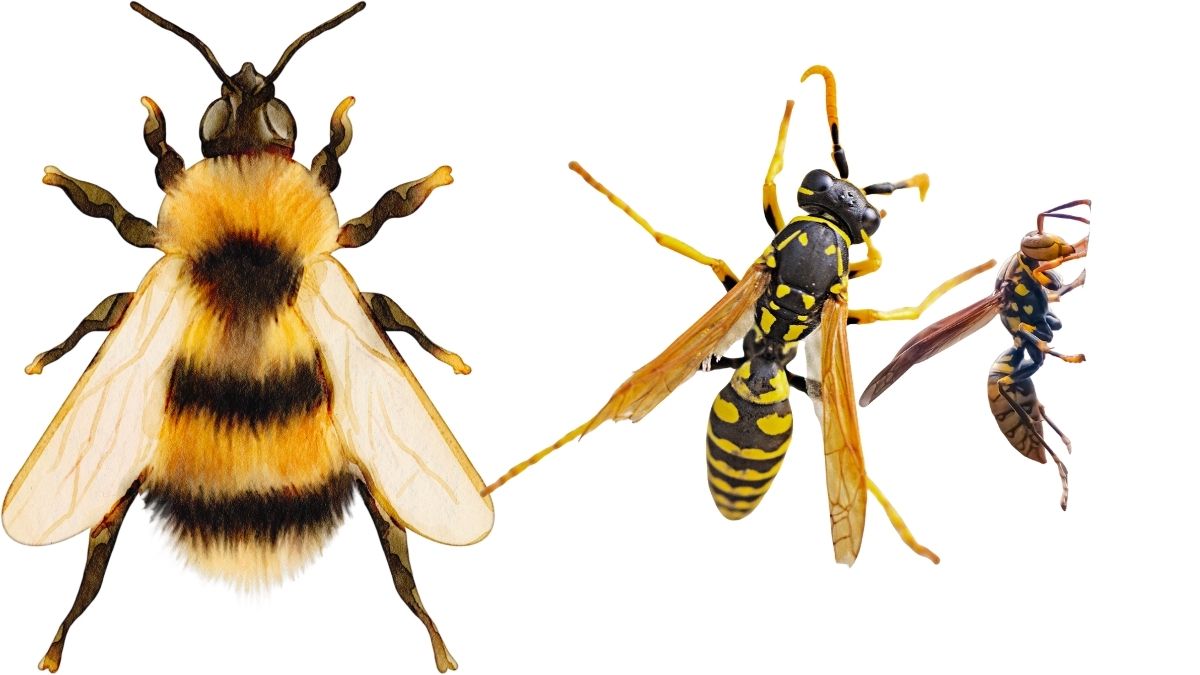
If a black-and-yellow insect just buzzed past your deck, the fastest way to identify it comes down to three quick checks: body texture, waist shape, and size. Bees are fuzzy and round. Wasps are smooth with a pinched waist. Hornets are simply larger, huskier wasps. Behaviour is the second clue. Bees are generally calm unless their nest is disturbed, wasps get defensive around food and around their nests, and hornets tend to react fastest and hardest when they feel threatened.
The rest of this guide breaks down each insect in more detail, covers where their nests tend to show up around homes in the GTA, and explains when it’s worth calling in a wasp control professional instead of getting a closer look yourself.
Bees vs Wasps vs Hornets
Here’s a quick comparison of bee vs wasp vs hornet.
| Feature | Bee | Wasp | Hornet |
|---|---|---|---|
| Body | Rounded and fuzzy, with hairy legs built for carrying pollen | Smooth and shiny, with a narrow “pinched” waist | Same smooth build as a wasp, just noticeably larger and huskier |
| Behaviour | Focused on flowers, generally calm unless its nest is disturbed | Drawn to food and sugary drinks, can get defensive near its nest | More aggressive when defending its nest, with a sting that tends to hurt more |
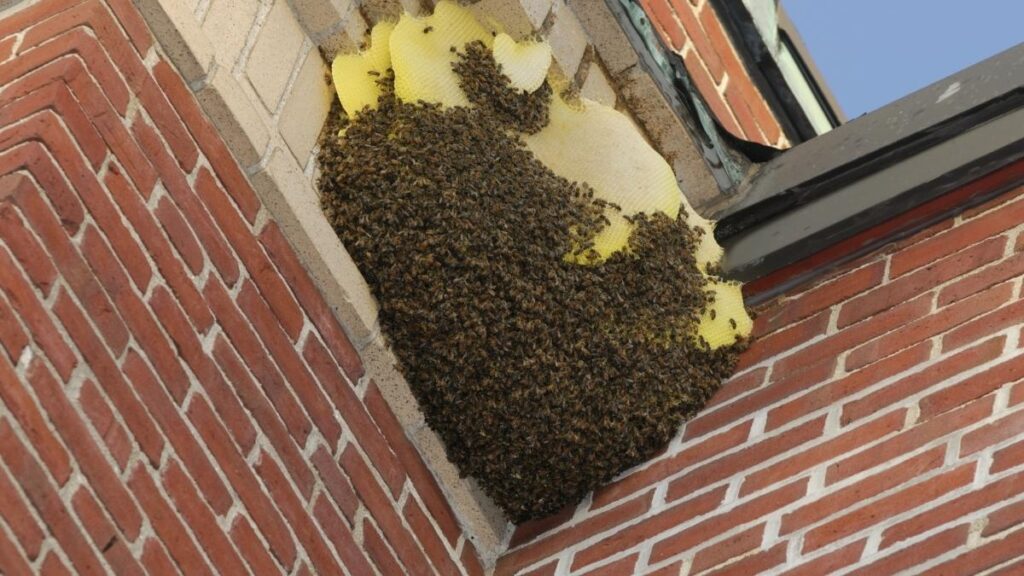
| Nest | Wax comb, built by species that live in colonies | Grey, papery nest made from chewed wood pulp | Similar papery material to a wasp nest, built into a larger, rounder shape |
| Typical location | Tree cavities, wall voids, or managed hives, depending on the species | Under eaves, inside sheds, in wall voids, or underground (yellow jackets) | Hanging from tree branches, tucked under rooflines, or inside wall cavities |
How to Identify a Bee
Bees are the most recognizable of the three because of their fuzzy, rounded bodies. That hair isn’t just for looks. It’s what lets bees pick up and carry pollen from flower to flower, which is also why you’ll mostly spot them around gardens and flowering plants rather than near food or garbage. Their legs are flatter and hairier than a wasp’s, and their head and thorax tend to blend together into one soft, bulbous shape rather than showing a clear “waist.”
Most bees are not aggressive by nature. A honeybee, for instance, will typically only sting if it’s directly threatened or if its hive is disturbed, and doing so is fatal to the bee itself since its barbed stinger stays behind in the skin. Bumblebees and carpenter bees can sting more than once, but they’re still not looking for a fight. If you’re seeing calm, hairy insects working over your flower beds, you’re almost certainly looking at bees rather than wasps or hornets.
Bees and wasps actually took separate evolutionary paths a long time ago, which explains why they look and behave so differently despite belonging to the same broader insect order. Bees stayed vegetarian, living off pollen and nectar, while wasps and hornets developed into hunters that feed on other insects. That single difference in diet is a big part of why bees are drawn to flowers and wasps are drawn to your picnic table.
How to Identify a Wasp
Wasps have smooth, hairless bodies and a clearly defined narrow waist separating the thorax from the abdomen. Unlike bees, wasps are carnivorous, hunting other insects to feed their larvae, though adult wasps mostly feed on nectar and sugary liquids themselves. That appetite for sweets is exactly why wasps show up at picnics and around garbage bins in late summer, when their own food supply from the colony starts to dwindle.
Two wasp types account for most of the sightings homeowners report in the GTA.
Paper Wasps
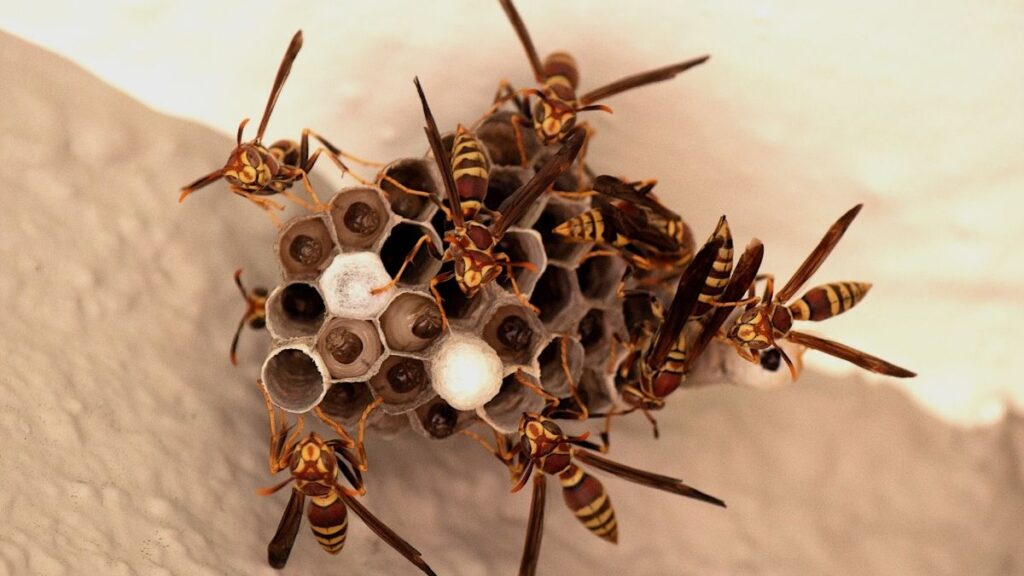
Paper wasps are typically brownish with yellow markings and have noticeably long legs that dangle below their body in flight, which is one of the easiest ways to tell them apart from a bee or a yellow jacket at a glance. They build open, umbrella-shaped nests out of chewed wood pulp and saliva, usually tucked under eaves, inside sheds, or in other sheltered spots. A paper wasp colony is relatively small, often somewhere between 15 and 200 insects, and while they can sting if you get too close to the nest, they’re generally considered less aggressive than yellow jackets.
Yellow Jackets
Yellow jackets are the wasp most of us imagine when we hear the word “wasp.” They have bold black and yellow banding, and unlike paper wasps, they tuck their legs in tight during flight. Yellow jackets are highly territorial and will defend their nest aggressively if they feel it’s threatened. Their colonies can be large, sometimes growing to several thousand workers by late summer, and they commonly nest underground, in abandoned burrows, or inside wall voids and other sheltered cavities. Because they’re scavengers as well as hunters, yellow jackets are the ones most likely to show up uninvited at a backyard barbecue, drawn in by anything from a dropped hot dog to an open pop can.
Both paper wasps and yellow jackets are social insects, meaning the whole colony works together under a single queen, and both colonies die off naturally over winter. A fertilized queen is the only one that survives the cold, tucked away somewhere sheltered until she emerges in spring to start an entirely new nest from scratch, which is why last year’s nest location doesn’t necessarily predict where this year’s will show up.
How to Identify a Hornet
Hornets belong to the same broader wasp family, and in fact every hornet is technically a type of wasp, though not every wasp is a hornet. What sets hornets apart is mostly size: they’re noticeably larger and more robust than the average wasp, with a similarly smooth body but a bulkier build overall.
Bald-Faced Hornets
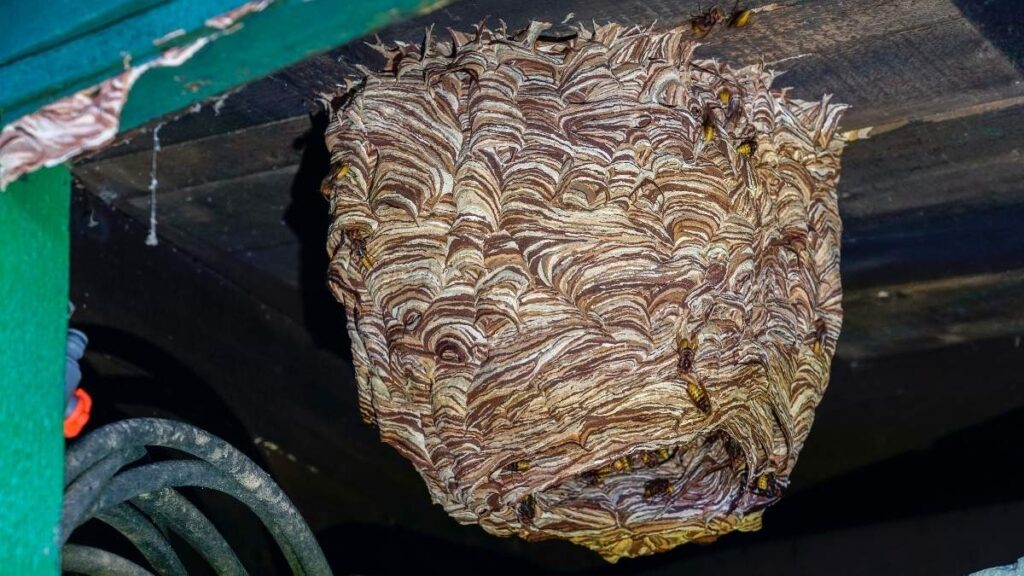
Despite the name, bald-faced hornets are actually closer relatives of yellow jackets than true hornets. They’re easy to spot thanks to their black bodies with distinctive white markings on the face and thorax. Bald-faced hornets build large, grey, football-shaped paper nests that hang from tree branches, eaves, or utility poles, and they’re known for being highly defensive around that nest, sometimes stinging repeatedly if they feel provoked.
European Hornets
The European hornet is Ontario’s closest match to a “true” hornet, with a brownish body, reddish head, and yellow abdominal markings. They tend to build their nests inside sheltered cavities such as hollow trees, sheds, or wall voids rather than out in the open, which can make them harder to spot until activity around an entry point gives them away. European hornets aren’t naturally looking for a confrontation, but their sting is generally more painful than a typical wasp’s simply because of their larger size and the volume of venom they deliver.
One more identification cue worth knowing: hornets tend to fly with a noticeably louder buzz than a wasp of similar colouring, simply because of their bulk. If something sounds unusually loud in flight before you’ve even gotten a good look at it, there’s a decent chance it’s a hornet rather than a wasp.
Where These Nests Show Up in the GTA
Where you find a nest is often as useful for identification as what the insect looks like.
Paper wasp nests tend to hang in the open, under eaves, porch roofs, or shed overhangs, where you can usually see the honeycomb-like cells from below. Bald-faced hornet and some yellow jacket nests are fully enclosed in that same greyish papery material, often high up in a tree or tucked against a roofline, and can grow to the size of a basketball or larger by late summer.
Ground nests are almost always a yellow jacket sign. They favour abandoned rodent burrows, gaps at the base of retaining walls, or loose soil in garden beds, and a nest entrance can be easy to miss until you notice repeated insect traffic in and out of a small hole in the ground.
Wall void activity is a pattern our Toronto technicians see often in older homes with brick veneer or gaps around soffits, where wasps or hornets find their way into a wall cavity through a small crack and build a nest that’s completely hidden from view except for insects flying in and out. In newer subdivisions around Vaughan, we more often see nests forming in sheds, under deck boards, or around the eaves of new-build homes where construction gaps haven’t been fully sealed yet.
Nest size is also a useful clue for timing. A nest that looks small and quiet in June can grow substantially by August or September as the colony reaches its peak size for the season, which is also when foraging workers become noticeably more active and more likely to wander toward human food. If a nest you’ve been keeping an eye on suddenly seems busier than it was a few weeks earlier, that’s a normal part of the late-summer pattern rather than a sign anything unusual is happening.
Why Getting the ID Right Matters
Correct identification changes how seriously you should treat a nest, and how close is genuinely safe to get. Hornets and yellow jackets are more likely to sting repeatedly and defend a nest aggressively, while a lone bee working a flower bed usually isn’t a concern at all. If you’ve spotted an active nest anywhere on your property, the safest move is to keep a comfortable distance, avoid swatting at individual insects, and steer kids and pets away from the area rather than approaching for a closer look or attempting removal yourself.
Stings from any of these insects can also trigger an allergic reaction, and reactions can sometimes worsen with repeat exposure over a person’s lifetime.
According to HealthLinkBC, symptoms can range from mild swelling at the sting site to anaphylaxis, a severe, life-threatening reaction that needs emergency care. The Canadian Paediatric Society notes that systemic allergic reactions affect a meaningful share of children stung by these insects, which is part of why a fast, cautious response matters, especially if you’re not sure whether anyone in the household has a known sensitivity.
If you’ve found what looks like an active nest and you’re not confident about how to approach it safely, our guide to wasp nest removal in the GTA walks through when it’s reasonable to keep an eye on a nest and when it’s time to bring in a professional for an assessment.
Bottom Line
Bees, wasps, and hornets can look similar from a distance, but a quick look at body texture, waist shape, and size usually gives you your answer. Bees are fuzzy and generally calm, wasps are smooth-bodied with a narrow waist and a taste for sweets, and hornets are simply the larger, more defensive end of the wasp family.
Where the nest is sitting, whether it’s hanging in the open, tucked into a wall void, or hidden underground, can tell you just as much as the insect itself. When in doubt, keep your distance and get a professional opinion before deciding on next steps.
FAQs
What’s the fastest way to tell a bee from a wasp?
Look at the body. Bees are fuzzy and rounded, with hairy legs built for carrying pollen. Wasps have smooth, shiny bodies with a clearly narrow waist and no visible hair. If it looks soft and round, it’s probably a bee. If it looks sleek with a pinched middle, it’s a wasp.
Is a hornet just a big wasp?
Essentially, yes. Every hornet is a type of wasp, though not every wasp is a hornet. Hornets are generally the largest members of the wasp family, with a similarly smooth body but a noticeably bulkier build and, in most cases, a more painful sting due to their size.
Why do wasps seem more aggressive in the GTA by late summer?
Wasp colonies peak in size around late summer and into early fall, when food that the colony would normally rely on becomes scarcer. Worker wasps shift toward scavenging for sugary and protein-rich food, which is exactly when they start showing up more at patios, garbage bins, and outdoor gatherings across Toronto and the GTA.
Where are yellow jacket nests usually hiding around a GTA property?
Most often underground, in an abandoned rodent burrow or loose soil near a garden bed or retaining wall, though they’ll also nest inside wall voids or other sheltered cavities. A steady stream of insects flying in and out of a small ground opening is usually the giveaway.
What should I do if I’m stung and I’m not sure whether I’m allergic?
Watch closely for symptoms beyond normal swelling and pain, such as hives spreading beyond the sting site, swelling of the face or throat, or trouble breathing. If any of those appear, treat it as a medical emergency and seek care right away rather than waiting to see if it passes.