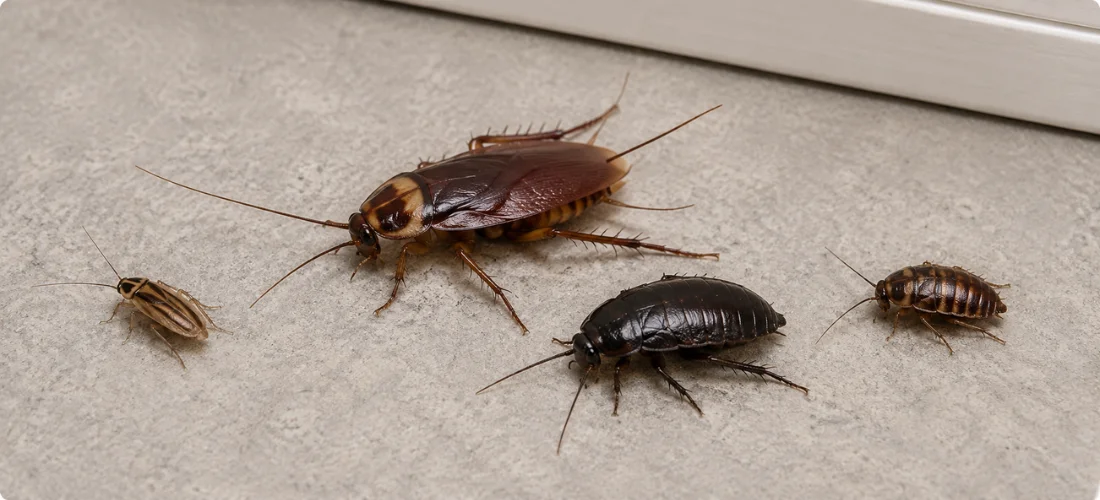
The four main types of cockroaches in Ontario homes are German, American, Oriental, and Brown-banded cockroaches. Their size, colour, markings, and preferred hiding places help distinguish them. German cockroaches are the most common indoor species, particularly in kitchens, apartments, restaurants, and other heated buildings.
Seeing a cockroach in your Toronto or GTA home deserves prompt attention. These insects hide in narrow cracks, remain active mainly at night, and can multiply before the infestation becomes obvious. Although other outdoor cockroaches may occasionally enter Ontario properties, four types of cockroaches in Ontario account for the main indoor concerns: German, American, Oriental, and Brown-banded cockroaches.
From a pest control perspective, identifying the species is an important first step because each one prefers different temperatures, moisture levels, and hiding places. A small tan cockroach behind a refrigerator requires a different inspection approach from a large, dark cockroach near a basement drain. This guide explains how to recognize each species and decide what to do next.
Types of Cockroaches Found in Ontario Homes
Ontario homes are most commonly affected by four cockroach species: German cockroaches, American cockroaches, Oriental cockroaches, and Brown-banded cockroaches. German cockroaches are by far the most common indoor pest, especially in Toronto and GTA kitchens.
The four main household species are:
- German cockroach: A small, tan cockroach with two dark stripes behind its head. It commonly infests kitchens and bathrooms.
- American cockroach: A large, reddish-brown cockroach with a pale yellow border behind its head. It prefers warm, damp areas.
- Oriental cockroach: A dark brown or almost black cockroach usually associated with cool, wet locations such as basements and drains.
- Brown-banded cockroach: A small brown species with pale bands across its body. It often hides in warm, dry areas away from kitchens.
These are the four principal indoor pest species, not necessarily every cockroach that could be encountered in Ontario. Outdoor wood cockroaches, for example, can occasionally wander indoors but generally do not establish the same persistent household infestations.
German Cockroach: Most Common in Ontario
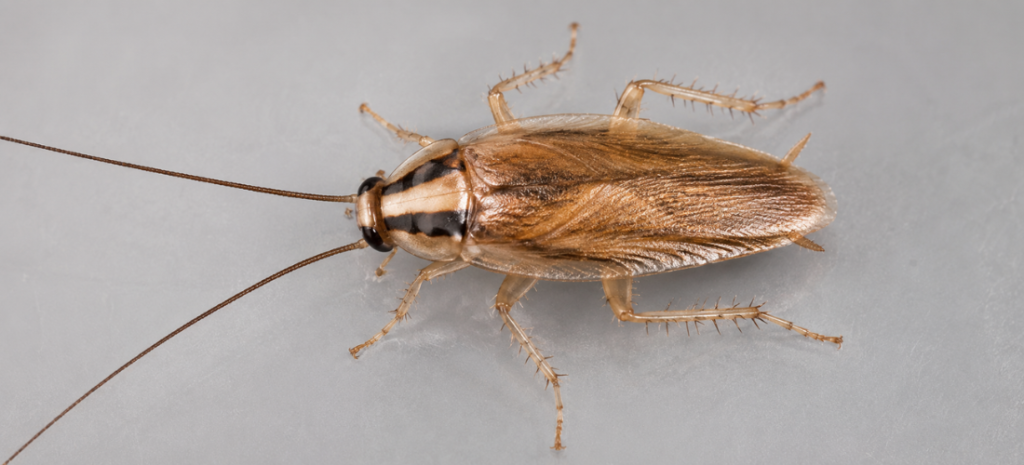
The German cockroach, Blattella germanica, is the species most likely to establish a serious indoor infestation in Ontario. It depends on heated buildings in colder climates and is frequently found in houses, condominiums, apartments, restaurants, grocery stores, and commercial kitchens.
What Does a German Cockroach Look Like?
Adult German cockroaches are approximately 13 to 16 millimetres long. Their bodies are light brown, tan, or yellowish-brown, with two dark parallel stripes on the shield immediately behind the head.
Both adult males and females have wings, but they normally run instead of flying. Young German cockroaches, known as nymphs, are smaller and darker. They may appear almost black, with a lighter stripe running along the centre of the back.
If you notice several small cockroaches in the kitchen, especially near a refrigerator, dishwasher, stove, or sink, German cockroaches are the most likely explanation.
Why Are German Cockroaches the Number-One Kitchen Pest in Ontario?
German cockroaches thrive where food, water, warmth, and narrow hiding spaces are available. Kitchens provide all four. Crumbs beneath appliances, grease beside a stove, condensation around pipes, and the heat produced by appliance motors can support an infestation.
They can enter a property inside cardboard boxes, grocery packaging, used appliances, furniture, deliveries, or belongings moved from an infested building. In apartments and condominiums, they may also travel between units through utility openings, shared plumbing routes, wall gaps, and service areas.
Their short reproductive cycle makes early intervention important. A few insects hidden behind an appliance can become a widespread infestation before residents regularly see them.
Signs You Have German Cockroaches
Common evidence includes:
- Live cockroaches running when kitchen lights are switched on.
- Small dark droppings resembling pepper or coffee grounds.
- Brown egg cases in cabinets, cracks, or appliance areas.
- Shed skins left by growing nymphs.
- Dark spotting around hinges, corners, and harbourage sites.
- An unpleasant, musty odour in a substantial infestation.
- Cockroach activity around sinks, stoves, refrigerators, or dishwashers.
Seeing German cockroaches during the day can indicate crowding, disrupted hiding places, or a growing cockroach infestation. However, time of day alone cannot determine its severity.
American Cockroach
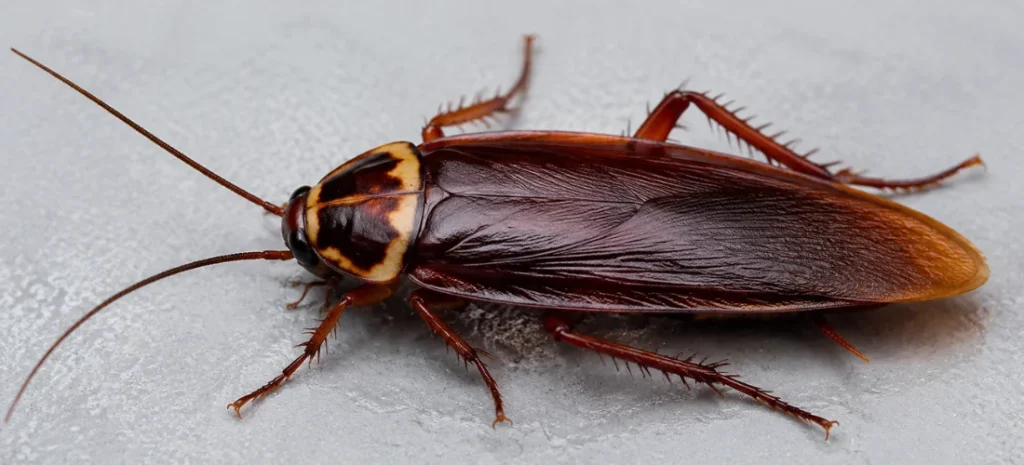
The American cockroach, Periplaneta americana, is one of the largest cockroach species that may be found inside Ontario buildings. Despite its common name, it is not native to North America. In Ontario, it generally survives in consistently heated, humid structures rather than outdoors throughout the winter.
What Does an American Cockroach Look Like?
Adults are usually about 35 to 40 millimetres long, although some can be larger. They are reddish-brown or mahogany-coloured, with a distinctive pale yellow or cream border around the shield behind the head.
Their long wings cover or extend beyond the abdomen. American cockroaches can glide or fly short distances under suitable conditions, although people more commonly see them running.
For brown cockroach identification, pay particular attention to size. A very large reddish-brown cockroach with a pale, figure-eight-like marking behind its head is more likely to be American than German or Brown-banded.
Where Are American Cockroaches Found in Ontario Homes?
American cockroaches prefer warm, humid areas. Possible locations include:
- Boiler and furnace rooms.
- Utility areas.
- Warm basements.
- Floor drains and plumbing spaces.
- Sewage and drainage infrastructure.
- Laundry rooms.
- Commercial kitchens.
- Food-storage or processing facilities.
A large cockroach discovered near a basement drain is not automatically an American cockroach. Oriental cockroaches also frequent damp lower levels, so body colour and markings should be examined before deciding.
Oriental Cockroach
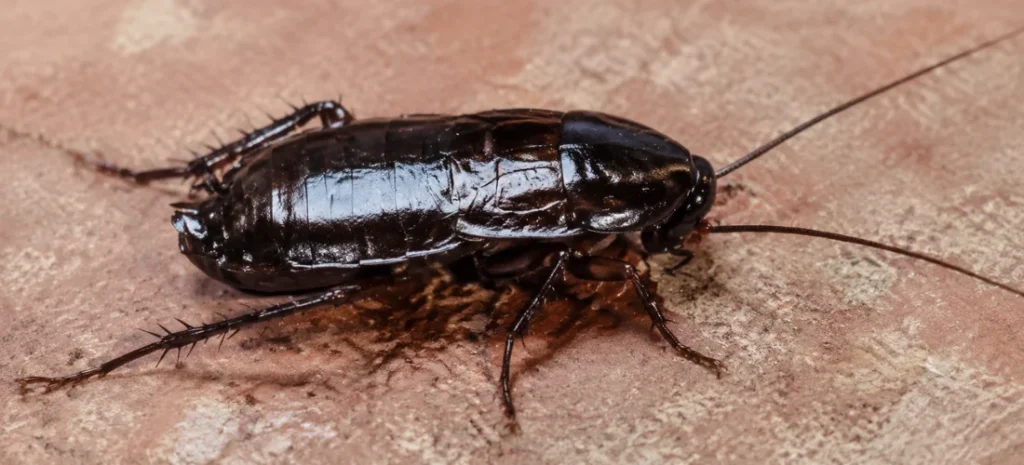
The Oriental cockroach, Blatta orientalis, has a dark, glossy appearance that causes some homeowners to mistake it for a black beetle. Compared with German cockroaches, it tolerates cooler environments and remains close to damp ground-level or below-ground areas.
Identifying Features
Adult Oriental cockroaches are generally around 20 to 25 millimetres long. They are dark brown, deep reddish-brown, or nearly black, often with a shiny or greasy-looking surface.
Males have wings that cover part of the abdomen, while females have only small wing pads. Neither sex is considered an effective flyer. Their movement may also appear slower than the quick, darting behaviour associated with German cockroaches.
The combination of a broad body, very dark colour, reduced wings, and a damp hiding place provides the strongest visual clue.
Where They Are Found
Oriental cockroaches favour cool, moist spaces containing decaying organic matter. They may be encountered around:
- Damp basements.
- Floor drains.
- Sump areas.
- Leaking pipes.
- Crawl spaces.
- Utility rooms.
- Garbage storage locations.
- Foundation gaps.
- Wet outdoor areas beside buildings.
Repeated activity may indicate excess moisture, a plumbing defect, or access through drains and structural gaps. Correcting those conditions should form part of the control plan rather than relying only on insecticide.
Brown-Banded Cockroach
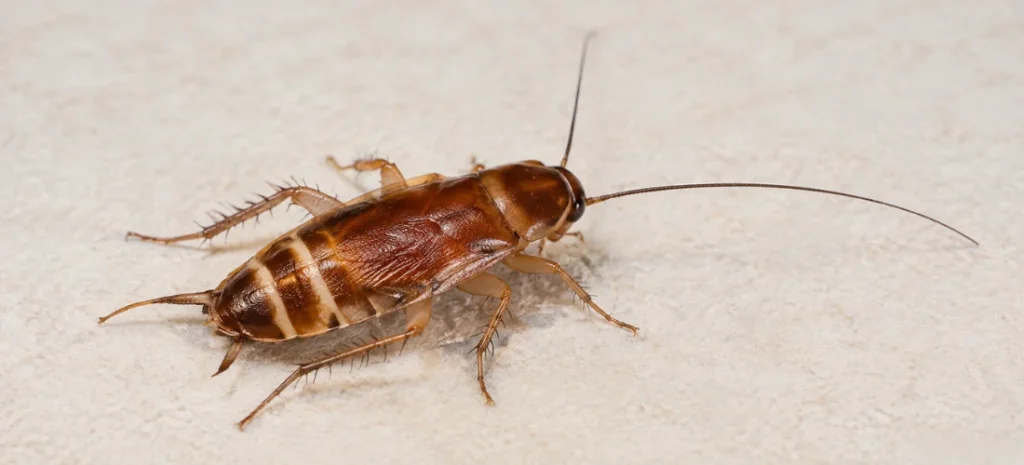
The Brown-banded cockroach, Supella longipalpa, is less common than the German cockroach but can still establish indoor populations. It prefers warm, relatively dry surroundings and may spread through rooms that would not normally be associated with kitchen pests.
Identifying Features
Brown-banded adults are approximately 10 to 14 millimetres long. Their name comes from the two light-coloured bands that cross the wings or abdomen.
Males tend to be slender and lighter brown, with wings extending over the abdomen. Females are broader and darker, with shorter wings. Young nymphs show the contrasting bands more clearly than some adults.
Unlike German cockroaches, Brown-banded cockroaches do not have two dark, lengthwise stripes on the shield behind the head.
Common Hiding Spots
Brown-banded cockroaches commonly select elevated, warm, and dry locations, including:
- Upper cabinets and shelving.
- Behind picture frames.
- Inside furniture.
- Around televisions and electronics.
- Near appliance motors.
- In bedrooms and living rooms.
- Behind loose wallpaper.
- Along ceilings and upper walls.
Females may attach egg cases beneath furniture or to other protected surfaces. Therefore, an inspection limited to sinks and lower kitchen cabinets can miss an established Brown-banded infestation.
German vs American Cockroach: Key Differences
German cockroaches are small, tan, and strongly associated with kitchens. American cockroaches are much larger, reddish-brown, and more closely associated with warm drainage, utility, or basement environments. The two dark stripes behind a German cockroach’s head are different from the pale border found on an American cockroach.
| Feature | German cockroach | American cockroach |
|---|---|---|
| Scientific name | Blattella germanica | Periplaneta americana |
| Adult size | About 13–16 mm | About 35–40 mm or more |
| Colour | Tan to light brown | Reddish-brown |
| Main marking | Two dark parallel stripes behind the head | Pale yellow border behind the head |
| Wings | Present, but rarely used for flight | Long wings; capable of limited flight |
| Common location | Kitchens, bathrooms, cabinets and appliances | Boiler rooms, drains, basements and utility areas |
| Typical Ontario pattern | Most common indoor infestation | Less common and associated with warm, humid structures |
| Movement | Fast runner | Fast runner; may glide or fly |
Size is normally the quickest distinction. An adult American cockroach can be more than twice the length of a German cockroach.
How to Identify a Cockroach in Your Home?
Accurate cockroach identification in Canada should combine several characteristics. Colour alone is unreliable because lighting, age, and recent moulting can change an insect’s appearance.
| What you observe | Probable species |
|---|---|
| 13–16 mm, tan, two dark stripes, found around kitchen appliances | German cockroach |
| 35–40 mm, reddish-brown, pale border behind head, found near a warm drain | American cockroach |
| 20–25 mm, shiny dark brown or black, reduced wings, found in a damp basement | Oriental cockroach |
| 10–14 mm, brown with two pale cross-bands, found high in furniture or electronics | Brown-banded cockroach |
| Light-coloured or almost white cockroach | Recently moulted cockroach, not a separate “albino” species |
| Cockroach found near firewood or an exterior door with no further indoor evidence | Possibly an outdoor wood cockroach |
If possible, take a clear photograph with a coin or ruler nearby for scale. Record where and when it was found. A secured specimen or detailed photograph can help a pest control technician make a more reliable identification.
Avoid crushing the insect if you intend to submit it for identification. Place it in a sealed container or bag without handling it directly.
Are Cockroaches in Toronto and the GTA a Bigger Problem?
Toronto and the GTA provide conditions that allow cockroaches to remain active indoors throughout the year. Heated buildings protect them from Ontario’s cold winters, while kitchens, utility rooms, plumbing systems, and service spaces provide food, moisture, and shelter.
Housing density can also complicate control. In high-rise apartments, condominiums, restaurants, and mixed-use properties, German cockroaches can move between adjoining spaces or be repeatedly reintroduced through deliveries and personal belongings. Treating one visible room may not address connected harbourages elsewhere in a unit or building.
Residents experiencing persistent activity can review Invaders Canada’s Toronto pest control services or its dedicated cockroach control service for local inspection and treatment information.
What to Do If You Find Cockroaches in Your Home?
Start by documenting the sighting and inspecting nearby areas with a flashlight. Look beneath sinks, around pipe openings, behind appliances, inside cabinet corners, and near hinges. Sticky monitoring traps can help show where cockroaches are travelling, but traps alone rarely eliminate an established population.
Remove accessible food, wipe up spills, empty indoor waste frequently, and store dry goods in sealed containers. Repair plumbing leaks and reduce condensation. Vacuum crumbs and visible cockroaches using a vacuum with a disposable bag, then seal and discard the bag outdoors.
Do not combine products without confirming that they are compatible. Repellent sprays used near gel bait can make the bait less effective or move cockroaches into other areas. Always follow the Canadian product label.
When DIY Treatment Works
DIY measures are most useful for prevention, monitoring, or an isolated accidental invader. They may be reasonable when:
- Only one outdoor-type cockroach has entered.
- No droppings, egg cases, nymphs, or recurring activity are present.
- The source is a correctable gap, delivery carton, or firewood.
- Monitoring traps remain empty after sanitation and exclusion.
- The resident can safely use a properly registered product according to its label.
A single German cockroach is different from an occasional outdoor visitor. Because German cockroaches live and reproduce indoors, even one sighting warrants careful inspection.
When to Call a Professional Exterminator?
Professional help is advisable when you see:
- German cockroaches, especially nymphs.
- Cockroaches on several consecutive days.
- Daytime activity.
- Multiple life stages or egg cases.
- Droppings in cabinets and appliance areas.
- Activity in more than one room.
- Recurring cockroaches after DIY treatment.
- Evidence in a restaurant, rental building, or commercial kitchen.
A professional inspection should identify the species, trace harbourage areas, assess moisture and entry points, and create a treatment plan. Effective programs may use monitoring, gel bait, dust, targeted applications, sanitation, exclusion, and follow-up inspections.
Get a Cockroach Identified and Treated by Invaders Canada
Invaders Canada provides cockroach inspection and control for residential and commercial properties across Toronto and the GTA. The process focuses on identifying the species, finding active harbourages, treating concealed areas, and addressing the conditions supporting the infestation.
If you have found a cockroach, take a photograph and note its size and location. You can then contact us to request an inspection or discuss the evidence you have found. Early action is especially important for German cockroaches. Waiting until they appear in several rooms usually makes treatment more difficult.
Conclusion
The four principal types of cockroaches in Ontario homes are German, American, Oriental, and Brown-banded cockroaches. German cockroaches are the most common and are usually found around kitchens and bathrooms. American cockroaches are much larger, Oriental cockroaches are dark and moisture-loving, and Brown-banded cockroaches often occupy warm, dry locations above floor level. Size, markings, and hiding location provide a better identification than colour alone. If you find recurring activity, young cockroaches, droppings, or egg cases, arrange an inspection before the population spreads into additional rooms or neighbouring units.
FAQs
What is the most common cockroach in Ontario?
The German cockroach is the most common indoor cockroach pest in Ontario. It is a small, tan species with two dark stripes behind its head and is frequently found in kitchens, bathrooms, restaurants, and multi-unit buildings.
Are large cockroaches common in Toronto?
Large American or Oriental cockroaches can occur in Toronto, but German cockroaches cause more indoor infestations. Large cockroaches are more likely to be associated with warm drains, utility rooms, damp basements, or building infrastructure.
Why am I finding small cockroaches in my kitchen?
Small tan cockroaches in a kitchen are often German cockroaches. Kitchens provide food, water, warmth, and protected gaps around cabinets and appliances. Look for two dark stripes behind the head and check nearby areas for droppings or nymphs.
Can cockroaches survive an Ontario winter?
Indoor cockroach populations can survive throughout winter because heated buildings provide stable temperatures. Some outdoor species have different seasonal adaptations, but German cockroaches depend heavily on protected indoor environments in Ontario’s climate.
Does seeing one cockroach mean there is an infestation?
Not always. An outdoor cockroach can enter accidentally. However, one German cockroach may indicate hidden activity because the species lives and reproduces indoors. The discovery of nymphs, droppings, egg cases, or repeated sightings makes an infestation more likely.