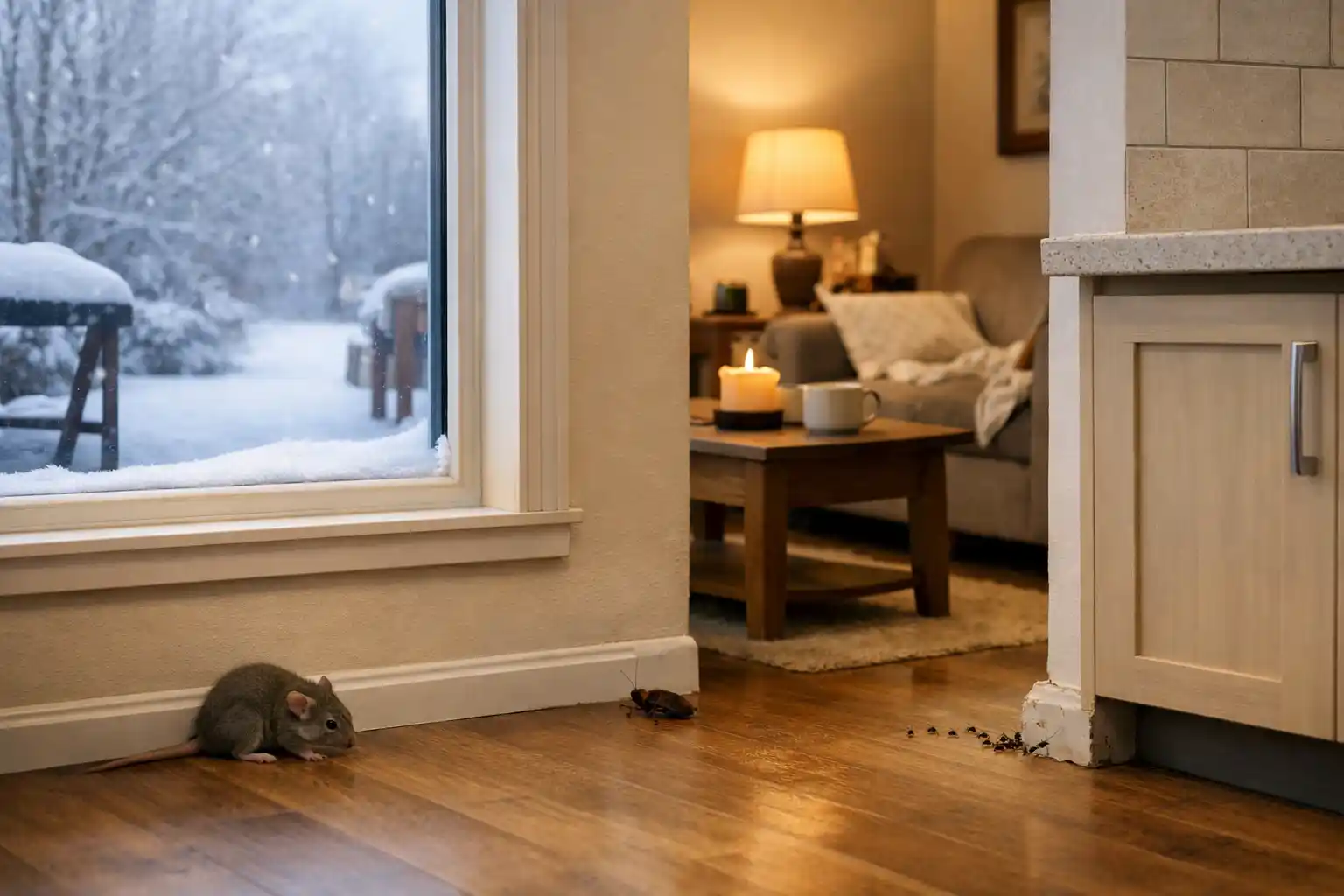
Quick Summary: As temperatures drop in the GTA, rodents and overwintering insects exploit tiny foundation cracks to turn heated homes into winter shelters. This post talks about the pests entering the homes in the Greater Toronto Area in winter, the warning signs to watch for, and the exclusion steps that actually keep them out.
The first hard frost across the GTA doesn’t just chill the air. It sends every mouse, cockroach, and cluster fly within a block of your house looking for a warmer address, and yours is often the closest option.
Residents in and around the Toronto, Peel, York, and Durham areas see the same pattern every year. Pest calls climb through November and December, right as furnaces switch on and outdoor food and water sources disappear under the season’s first snow.
Pests don’t really hibernate through an Ontario winter so much as relocate. Wall voids, basements, cold rooms, and attic spaces hold steady between roughly 18°C and 22°C even when it’s -15°C outside, and that temperature gap is what drives the seasonal migration indoors.
This guide walks through which pests actually show up in homes across the GTA each winter, the entry points local housing stock tends to leave open, and the exclusion steps that separate a one-time sighting from a season-long infestation.
For homes already dealing with active activity, our licensed pest control services across the GTA cover everything from inspection through full exclusion.
The Freeze-Thaw Drive: Why Pests Target GTA Homes in Winter
Southern Ontario’s freeze-thaw cycle is hard on outdoor pest populations in a very specific way. Once ground temperatures drop below freezing, standing water disappears, soil-dwelling insects go dormant, and the outdoor food supply for rodents and insects largely vanishes.
Pests that can’t survive a hard freeze face a simple choice: find shelter or die.
A heated home solves that problem instantly. Basements, mechanical rooms, and wall voids in an average house in GTA stay warm enough through the coldest months to suit most household pests and rodent species. Add a steady supply of pantry food, unsealed garbage, or pet food left out overnight, and a warm home offers nearly everything a mouse or cockroach needs to survive winter, and to keep reproducing while it’s at it.
Housing density adds a layer specific to this region. Toronto’s older semi-detached homes and rowhouses, plus the connected townhomes common across Brampton, Vaughan, and Markham, often share walls, attics, or utility lines between units, so a pest problem in one unit can move sideways into the next without ever going outside. That’s part of why winter infestations spread faster in dense neighbourhoods across the GTA than in a detached suburban home.
Identifying the Top Winter Invaders in GTA
Rodents aren’t the only uninvited guests looking to escape the cold this season.
House Mice and Norway Rats
House mice (Mus musculus) are the winter pest people living in the GTA report most often. A mouse can flatten its skull slightly and squeeze through a gap about a quarter-inch wide, roughly a pencil’s width, which describes most of the small construction gaps around a typical foundation. Norway rats need a bit more room, closer to the width of a quarter, but they’re just as persistent once they find an opening.
Both species are mostly nocturnal, so the first sign is usually scratching inside walls between 11 PM and 3 AM rather than a daytime sighting. Dark, rice-sized droppings in cabinets or along baseboards, and gnaw marks on wiring or food packaging, are the next things worth checking for.
One myth needs to busted here: the hantavirus strain found in Canada is carried mainly by deer mice in rural and semi-rural areas, not the house mice typical of a basement.
That doesn’t make house mouse droppings harmless, though. They still carry Salmonella and other bacteria, and the Government of Canada advises against sweeping or vacuuming dry rodent droppings, since that can release contaminated particles into the air.
Our rodent control service covers identification through full exclusion once mice or rats are confirmed active in a home.
German and Oriental Cockroaches
German cockroaches cluster around anything warm and damp: behind stoves, under sinks, and inside dishwasher motor housings. Oriental cockroaches prefer cooler, damper spots and turn up more often in unfinished basements, cold cellars, and near floor drains.
Pepper-like specks in drawers, a persistent musty odour, and any daytime sighting are the signs worth acting on. Cockroaches are nocturnal, so seeing them in daylight usually means the usual hiding spots are already full.
The health angle is worth noticing too. Cockroach droppings, saliva, and shed skins contain proteins that are a well-documented asthma and allergy trigger, particularly in children, and in a sealed-up home running the furnace all winter, those allergens have nowhere to go.
Our cockroach control service targets the visible population and the hidden egg cases that keep an infestation coming back.
Overwintering Insects: Cluster Flies, Stink Bugs, and Seed Bugs
Cluster flies, brown marmorated stink bugs, and western conifer seed bugs all follow a similar pattern. They enter attics and wall voids in late autumn looking for a place to spend the winter, then reappear near windows on any unusually warm winter afternoon as sunlight warms the wall cavity.
None of the three reproduce indoors or damage the structure, but the brown marmorated stink bug has become a genuine nuisance across Southern Ontario in recent years. Field surveys have confirmed overwintering populations in Toronto, Vaughan, Brampton, and Milton, clustered on south- and west-facing walls where soffit gaps and window frames offer the easiest way in. They don’t bite or sting, but disturbing one releases the odour the species is named for, which is reason enough to seal entry points before a large group settles into the attic.
Dormant Structural Pests: Carpenter Ants
Carpenter ant sightings between November and February are a different kind of warning. Cluster flies and stink bugs are usually just passing the winter indoors, but carpenter ants seen inside a heated home in January typically mean an established satellite colony is already nesting in moisture-damaged wood framing, often near a historical leak, a bathroom wall, or a window sill.
Carpenter ants don’t eat wood the way termites do; they excavate it to build galleries, and an indoor satellite colony can keep expanding that damage through the coldest months if the moisture source that attracted it never gets fixed. Our ant control specialists can trace an indoor sighting back to the nest, the only way to stop the damage rather than just the ants you can see.
Winter Pest Vulnerability & Risk Matrix for GTA
| Pest Type | Primary Entry Points | Favorite Indoor Hiding Spots | Primary Damage / Health Risk | Detection Difficulty |
|---|---|---|---|---|
| House Mice | Weep holes, foundation cracks, pipe penetrations | Wall voids, basement insulation, cold rooms | Gnawed wiring (fire risk), Salmonella, food contamination | Moderate (scratching, droppings) |
| German Cockroaches | Plumbing gaps, shared walls, cardboard boxes | Behind stoves, under sinks, dishwasher housings | Asthma and allergy triggers, bacteria spread | High (nocturnal, hides in tight cracks) |
| Cluster Flies | Soffit gaps, attic vents, window frame gaps | Attics, wall cavities, upper-floor window sills | Nuisance staining; can attract carpet beetles | Low (visible near sunny windows) |
| Carpenter Ants | Damaged rooflines and fascia, moist subflooring | Wall studs near historical leak zones | Structural wood damage from nest excavation | High (silent winter activity inside walls) |
Where Pests Enter: Common Vulnerabilities in GTA
GTA housing stock has a few structural quirks that make winter pest entry more likely than in newer, more uniform housing markets, and most homeowners never think to check them.
Brick veneer weep holes are the biggest one. These small drainage gaps, spaced every couple of feet along a brick exterior wall, exist to let moisture drain out of the wall cavity, so covering them completely can trap water and cause rot. The right fix is a stainless-steel or copper mesh insert, not spray foam or caulk. Mice and rats can chew through standard expanding foam within days; they can’t chew through mesh.
Utility and HVAC conduits are the second common gap. Unsealed openings around gas lines, A/C linesets, and outdoor faucets are usually just large enough for a mouse, and they’re rarely inspected because they sit behind shrubs or under a deck.
Roofline and soffit damage, often from ice damming after a heavy snowfall in GTA, opens routes into the attic that cluster flies, stink bugs, and squirrels all use. A damaged fascia board, an uncapped chimney, or an unmeshed dryer vent is an easy fix in the fall and a much harder one once pests have already moved in.
Door and window weatherstripping, along with crawl space access panels, rounds out the list. A worn door sweep with even a quarter-inch gap is wide enough for a mouse, and older window frames common in Toronto’s pre-war housing stock often have gaps that widen every winter as the wood contracts in the cold.
Step-by-Step Winter Pest Exclusion Checklist
Exterior Perimeter Inspection
- Walk the foundation perimeter with a flashlight on a dry day, checking weep holes, utility penetrations, crawl space vents, and foundation cracks.
- Pack gaps with steel wool, then finish with silicone caulk under half an inch or rodent-resistant expanding foam for larger gaps. Steel wool alone resists chewing far better than foam or caulk on its own.
- Cover weep holes with a stainless-steel or copper mesh insert rather than sealing them shut, so the wall cavity can still drain.
- Fit chimney caps and cover dryer and attic vents with 1/4-inch galvanized hardware cloth; standard window screening is too coarse to stop a mouse.
- Keep firewood stacked at least 20 feet from exterior walls, since woodpiles are a favourite overwintering site for insects.
Interior Environmental Controls
- Store dry pantry goods in rigid glass or hard plastic containers. Most pests chew through original cardboard or plastic packaging easily.
- Run a dehumidifier in damp basements and cold rooms, keeping humidity below 50%, since moisture draws cockroaches and carpenter ants indoors.
- Swap cardboard storage boxes in attics, basements, and crawl spaces for sealed plastic totes. Cardboard doubles as food and nesting material.
- Empty pet food bowls and indoor garbage overnight rather than leaving them out, especially in kitchens and mudrooms.
Professional Winter Pest Elimination in the GTA
DIY sealing and sanitation solve a lot of winter pest problems, but a few signs mean it’s time to call a professional rather than keep troubleshooting alone: persistent nocturnal scratching that doesn’t stop after a week of sealing effort, daytime cockroach sightings or recurring droppings in food storage areas, and any carpenter ant sighting inside a living space during winter.
Invaders Canada is licensed under Ontario’s pesticide licensing framework, administered by the Ministry of the Environment, Conservation and Parks, and our technicians use eco-friendly, pet- and family-safe treatments across every GTA location we service, from Toronto and Etobicoke to Vaughan, Markham, and Durham Region.
We offer same-day dispatch for urgent winter infestations, and our approach goes beyond trapping the pests you can see: we locate and seal the entry points that let them in, so the same problem doesn’t return next time it’s cold.
If you’re hearing scratching in the walls or finding droppings you can’t explain, book a free inspection and we’ll identify exactly what’s active in your home and where it’s getting in.
FAQs
Why do I have bugs in my house in the middle of winter?
Cold weather forces insects like cluster flies, stink bugs, and cockroaches into warm microclimates inside wall cavities, attics, and heated basements, where they can survive until spring.
Can pest control be done effectively during cold Ontario winters?
Yes. Winter is actually a strong time for pest control because pests concentrate inside heated structures rather than spreading across a property, which makes targeted treatment and exclusion work more effective than in summer.
Will mice leave my GTA home on their own once spring arrives?
Usually not. Once mice establish a nest with reliable access to food and water, they tend to stay and reproduce rather than move back outside, even after the weather warms up.
What’s the fastest way to find where pests are entering my home this winter?
Walk the foundation perimeter with a flashlight and check weep holes, utility lines, and soffits first, since those account for most entry points. A professional inspection can catch gaps a visual check alone misses, using tools like borescopes to see inside wall cavities.